
DESCRIPTION
According to the Microsoft Developer Network, HttpOnly is an additional flag included in a Set-Cookie HTTP response header. Using the HttpOnly flag when generating a cookie helps mitigate the risk of client side script accessing the protected cookie (if the browser supports it).
If the HttpOnly flag (optional) is included in the HTTP response header, the cookie cannot be accessed through client side script (again if the browser supports this flag). As a result, even if a cross-site scripting (XSS) flaw exists, and a user accidentally accesses a link that exploits this flaw, the browser (primarily Internet Explorer) will not reveal the cookie to a third party.
~https://owasp.org/www-community/HttpOnly
In other words, the httpOnly flag secures application’s cookies by preventing a web browser from accessing cookies using JavaScript. In such case attacker who finds a Cross Site Scripting vulnerability will not be able to extract it by accessing document.cookie.
Even with httpOnly flag is in place when even one application’s module is poorly designed, attacker can achieve his/her objective and steal the cookie – if session cookie is reflected in HTTP response body an attacker can use a simple regex to retrieve desired string (cookie value) from response body and steal it like the flag never existed.
PROOF OF CONCEPT
The session cookie is named sessid and its secured by httpOnly flag.
The listing below presents a default JavaScript injection for a parameter found to be vulnerable to Cross Site Scripting:

The below screenshot confirms the vulnerability existence:

During the tests it was found out that one of application’s pages contains a session cookie in HTTP response body:
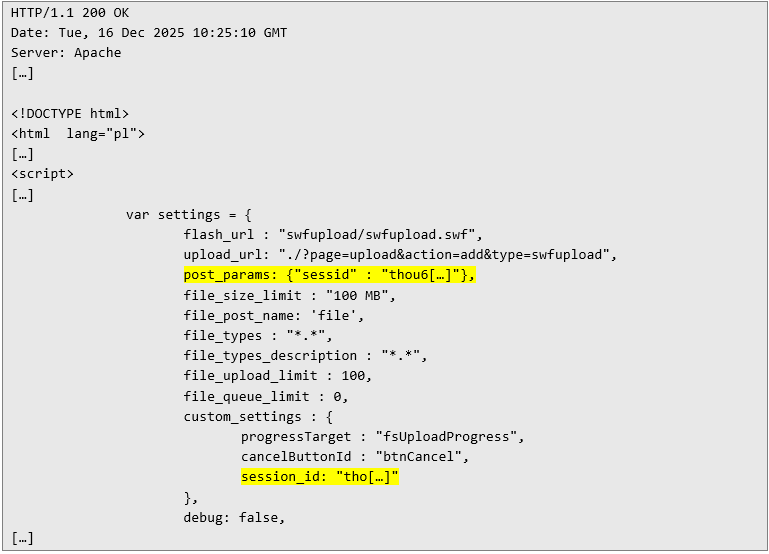
As mentioned before, such behavior can be leveraged to steal a session cookie even if httpOnly flag is in place.
Below there is a JavaScript code which:
loads the page where session cookie is disclosed in the HTTP body,
extracts the cookie value using the regex,
sends extracted line to the attacker-controlled server.

Below there is a full link which can be directly passed to the victim in order to execute the attack:

Opening the link in a victim’s browser triggers 3 steps which leads to retrieving the cookie on the attacker-controlled server:
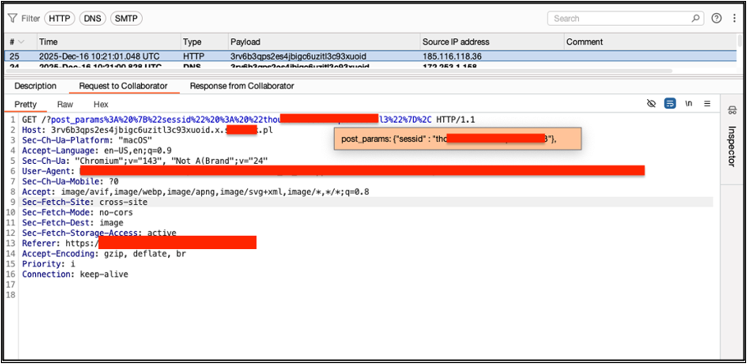
As demonstrated above, even when using the httpOnly flag, a web application can still be vulnerable to cookie stealing if there is a single point of failure. Based on that make sure that application never reveals session cookies in server’s responses.