
Credentials exposure in tinycontrol devices

Illustration of Credentials exposure in tinycontrol devices
Paweł Różański

Description

It seemed to be a usual LAN test, but the network contained some non-typical devices. One of them was an IoT device (LAN controller), which looked interesting. It had separate admin and user accounts. The user had only read-only permissions, but a default password. The password for the admin was changed from the default one.

We decided to check if there is a possibility to perform command injection or read sensitive files. Instead, I found something more interesting: during the opening of the login page by an unauthorized user, the file login.json was fetched from the device.

Request:

Response:
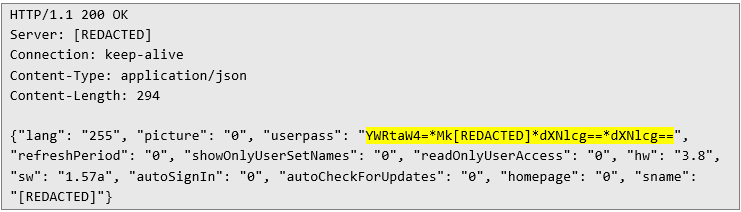
The userpass field was very interesting, I was immediately struck by familiar base64 strings. It turned out that it contains base64 encoded usernames and passwords, encoded with base64 and separated by asterisk.

Impact

What is the impact? In the worst-case scenario remote, unauthenticated attacker can log in as an administrator, no matter how complicated the password is. Later, after contact with the vendor, it turned out that if recommended configuration is applied instead of default one, attacker may need initial access to the device as a user (need to know user password), so it is “barely” privilege escalation.

Quickly checked release notes, found no signs of fixing this issue, so after informing our customer about security finding in the tested network – decided to contact the vendor. With the help of CERT Polska, CVE-2025-1150 was published.

Timeline

29.07.2025 – Initial contact with the vendor.

21.08.2025 – Full details sent to the vendor.

16.03.2026 – CVE published.

Other Insights

Illustration of The Danger of Leaking Cookies in HTTP Response Bodies

The Danger of Leaking Cookies in HTTP Response Bodies

Marcin Zięba

According to the Microsoft Developer Network, HttpOnly is an additional flag included in a Set-Cookie HTTP response header. Using the HttpOnly flag when generating a cookie helps mitigate the risk of client side script accessing the protected cookie (if the browser supports it). If the HttpOnly flag (optional) is included in the HTTP response header, the cookie cannot be accessed through client side script (again if the browser supports this flag). As a result, even if a cross-site scripting (XSS) flaw exists, and a user accidentally accesses a link that exploits this flaw, the browser (primarily Internet Explorer) will not reveal the cookie to a third party.

READ article
Illustration of The Legacy of VB6 and the ClientSide Auth Bypass

The Legacy of VB6 and the ClientSide Auth Bypass

Robert Kruczek

In the modern era of microservices and single page applications, we sometimes forget the „old times” of desktop development. Recently, we had the pleasure of testing a legacy desktop application written in Visual Basic 6 (VB6). What started as a routine assessment ended with us dusting off our reverse engineering skills to write a classic “crack”, proving that client side logic is never to be trusted.

READ article
A professional cybersecurity consultant ready to assist with your inquiry.

Any questions?

Happy to get a call or email
and help!